Showing posts with label deck. Show all posts

False battens blocking for deck framing and shiny stuff

Trying to push this project on toward completion, tonight I started measuring for the deck framing. So far, it has been mercifully simple.

I clamped my big adjustable T-Square onto the forward frame at the centerline, and measured the halfway point between the frame and the breasthook. Then, I set my 48" ruler across that halfway point, at right angles to the T-Square. After determining the rulers contact point with the sheer was an equal distance from the frame on both sides, I clamped the ruler into place, and marked the sheers. Then, I measured the angle at the intersection of the ruler and the sheer. Thankfully, it was a very easy-to-cut 20°. 

Measuring for the deck framing.

The blocking for the deck framing required a simple 20° cut. Here is the starboard side being epoxied into place.

Blocking for the deck framing on the port side.

Here, the false battens on the floor are being epoxied into place. All those boards look a little excessive to my eye, but the false battens do serve a practical purpose.

Tonight I drilled the holes & installed the stainless steel grab handle on the forward frame. The first time I rode in a Glen-L Utility, I realized this is a "must-have" item.

Progress...

Read More..

Eastern Arctic Kayak Construction Interlude

Yesterday I blocked in the keelson on  the inverted deck of the kayak in preparation for installing the ribs.  I am now at a crossroads where there are a number of ways to construct the ribs.  Not knowing exactly what the shape of the bottom of the kayak should be since I have never built this type of kayak before, I have to come up with a way to do this.  I can think of any number of ways to proceed but would like to go with the aboriginal scheme of shaping the ribs, whatever that is. 
Zimmerly is of no help here. His article in Sea Kayaker gives you the exact dimensions to cut the ribs to.  This only works if you also shaped the deck exactly like he instructed.  Since my deck is not shaped like his, his dimensions will do me no good.
I could do the ribs the way I normally do them, that is, steam bend them which would produce rounded chines and a slightly rounded bottom, but I want to go for the flat bottom and hard bends in the ribs approach that is more common for the EA kayak.  I guess I will just have to experiment and see what happens.

Read More..

Eastern Arctic Kayak Construction adding the deck beams

Construction progresses.  After I set up the deck, I started adding deck beams.  They are temporarily nailed in place 3/4 inches below the top of the gunwales. 

Before starting to add deck beams, it is a good idea to stabilize the deck by lashing the ends together and also doweling the two sides together so they dont shift with respect with each other which would cause asymmetry in the deck.
The deck prior to pegging the ends and dropping in deck beams.
And here, at the end of the day, all the flat deck beams are trial nailed in place.  You could of course dowel all the deck beams in place as you go but trial nailing them lets you do some last minute adjustments in deck shape before committing to more permanent joinery.
The last two deck beams to be added are the two curved ones just fore of the cockpit.  Shaping them is more time consuming than shaping the flat ones.  Unlike the flat deck beams which are mounted 3/4 inches below the top of the gunwales, the curved beams are mounted flush with the tops of the gunwales.  A batten is temporary clamped in place to show the curve that the deck stringer will take.  The beam just in front of the cockpit will elevate the front of the coaming 4 inches above the deck.
And here is a view down the length of the boat with all the deck beams in place.  The number of beams, coincidentally is less than in a traditional boat to keep down the overall weight of the finished boat.
And just before I started adding in the two curved deck beams, I had a crisis of faith about where the widest part of the boat should be.  Seemed like it wasnt far back enough.  But then I checked back with the drawing in Arimas book on EA kayaks and it appears that my placement was OK.  Seems that the original for this adaptation was a demo boat done for a Canadian museum and was shorter than the type usually is because available lumber was only 16 feet long.  So a shorter version with a slightly more forward beam was built.  In any case, the first boat of a type is never just right and gets modified when the second one is built.
Read More..

Deck framing completed

I suppose this wraps up the "blocking" phase I mentioned about a month ago. The last of the blocking was to support the deck framing, (which, on this little boat, only consists of two parts: a deck beam and a strongback).

I wasnt exactly sure where or how to trim and attach the strongback. I wound up following some examples from photos Id seen online, and I trimmed it short enough to let it mate to the back of the breasthook. Its hard to tell just yet, but that may have created an excessive downward curve. Time will tell. Once I get the bow and the remaining parts of the sheers faired in preparation for the decking, I should be able to tell if it will need a little shim on the top or not.

The deck framing is simply epoxied into place... no screws. Heres a photo of all the clamps & spreader bars involved.

Deck framing with the clamps removed.


Blocking for the strongback, on the back of the breasthook.

Blocking on the sheers, to support the deck beam.

Blocking on the back of frame #2, to support the strongback.

Notch in the deck beam for the strongback.

This part at the bow needs to be faired before the decking can be put on.

Read More..

Deck Carlins and shop maintenance

The temperature in the garage is now below 40 degrees, so I am refraining from doing any serious amount of gluing and epoxying.  I did discover that I can assemble the structures temporarily using hot melt glue.  This has allowed be to physically test the rowing positions, and the angle of the deck carlin (to which the combing gets attached).  This is a good find and will glue the blocking in place when we get a warmer day.  Other off season projects are:

  • complete purge of the basement workshop
  • clean and reorganize the garage building space
  • sharpen hand tools and saws
  • throw out all broken tools and replace with working ones.  
  • Sift through the paints, varnishes, and toss or replace as needed
  • discard worn out brushes
It seems as if I have acquired many, many handtools over the past 50 years.  Some belonged to my grandfather, my father-inlaw, and his father.  Some of these are unique,  others not so much and of questionable value.


11-25-14
Some surprise weather today! 60 degrees, so deck carlins are in as well a oarlock locations, and stern deck framing.  Have started on the cockpit hatches as well.  Working on the corner pieces that need 13" radius.  and 8" radius,  also need to add plywood gussets.


Put a chisel through my finger cutting this block down to size to bolt the stem fitting through by freehanding the 3/4" chisel and NOT wearing gloves.  Bad idea.  Could have been more serious.  


December 19 update
Was tired of looking at the remaining plywood at the back of the garage and figured I would at least lay out the decking in the rough to see what it would look like as well as gauge whether or not I will need one more sheet of plywood.  This all now depends on whether or not I use 1/4" okoume for the combings or use some other wood.  Honestly, the cost would be about the same so will probably go with ash as it shapes well, bends well, and looks fantasic under varnish.  It is prone to rot, so keeping up the finish is essential.  


It now looks like a boat!  

Other project this month is to finish the rudder and tiller assembly as well as mount the gudgeons and pintles.  
Tiller.  Roughed to shape.


Read More..

Beginning the deck framing


Primarily due to budget restrictions at the moment, I decided to build the deck framing out of southern yellow pine. After digging through every board at Lowes until I found one with relatively vertical grain (if its a good 45° diagonal or better, Ill take it), I walked out with enough wood to build the deck framing for about $7. Not bad.

Besides, Ive entrusted my chines and sheers to this strong, flexible, and affordable wood, so I have no problem at all using it for deck framing.

The first step was cutting the actual deck beam (the part that fits crosswise from sheer to sheer). The widest distance at the blocking for the deck frame measured 42 inches. So, I measured & marked the board, and cut it with my circular mitre saw set at 20° to match the curvature of the sheer. Then, I clamped the cut board to the back of the forward frame, and traced the curvature (crown) of its deck beam onto the pine.

I cut it, and fit it into place. The photos easily tell the rest...

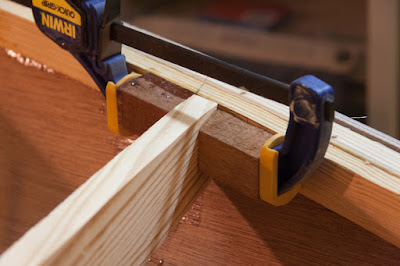
Deck beam clamped into place against the blocking on the starboard side.

Once the deck beam is epoxied into position, I will add additional blocking on the forward side, like this.


Port side, with the deck beam and forward blocking clamped into place.


Thank you for taking the time to read my blog, by the way. I hope that you find it helpful.
Read More..

Deck Hardware and sail report

July 20, 2015

Sorry for the lack of updates.  But, I wanted to go sailing this summer and decided to put the computer on hold in exchange for a full focus on finishing the boat.

Deck hardware was installed with backing blocks, and polysulphide sealant.  It is amazing how many little screws, washers, lock washers, bolts, and nuts are needed to install the cleats and blocks.  This necessitated no fewer than 5 trips to my local hardware store that has a very good selection of stainless steel hardware (amazingly out of $10 lockwashers).  The only tricky part was the installation of the centerboard downhaul and uphaul, as this was a new type of system I needed to learn as I went along.  In practice, it works well, but necessitated shaving down the aft part of the floorboards that serve as a platform up front so that the lines would run free.


I also needed to move the boat onto the trailer, which meant the 18 workskiff needed to come off.  Using levers and jacks, I was able to lift the 1000lb clamming skiff off the trailer and then slide the Core Sound 17 onto the trailer from the building form using old rugs to protect the finish.  


The CS17 fits perfectly.  

I still need to add the self-bailer, and the docking hardware, and oarlocks, but it was time to get out on the water and see how long it would take to rig and launch.  

30 minutes to step masts and rig.  could be 15 without mistakes. 
As you can see from the photo above, there was very little wind, but the boat moved along even with ghosting conditions.  

photos of the launch. 
https://www.flickr.com/photos/41024536@N02/sets/72157655720562508

July, 21,2015
Went out to Hopkinton State Park.  It was much better with winds 5-12kts.  The boat sails beautifully, and points very well.  I was very pleased with how easy the boat is to control and how well it responds to gusts.  I felt in control at all times throughout.  

Sorry, no photos, I had my hands full.  


Read More..

Methane Vents


As  permafrost melts, it releases methane. The methane exits the permafrost via vents which until recently were  small like the one pictured  but in the past year have increased in size to hundreds of feet across.  Careful when you light a cigarette.

Forget the effect of CO2 in the atmosphere on the temperature of the earth.  Methane is the gas du jour because it is 26 times as good an insulator as CO2.  CO2 is merely a gateway gas that sets us up for methane, the really bad stuff.  If you think where you live isnt warm enough, methane is the answer.  A little video here. I am providing a link since the blogger cant be embed flash videos. So flare away.
Actually, we did need to increase the CO2  in the atmosphere to the point where the Arctic was warm enough to release methane on its own accord.  We seem to be there now. Each year promises more melting in the Arctic and further release of methane. So CO2 did its part and can now step into the background.
What does this have to do with skinboats?  Nothing really other than that their use has very little effect on either CO2 or methane concentrations in the atmosphere.  Skinboats, in the current lingo are practically carbon neutral or can be made to be carbon neutral with some effort.  On the other hand, using skinboats does nothing to reduce the release of methane into the atmosphere and though it isnt hurting things, it isnt helping either.

Read More..

Eastern Arctic Kayak Construction Doweling and lashing the deck beams

In the previous post we looked at cutting and installing all the deck beams.  I chose to temporarily nail them in place.  While the method I chose is not traditional for this type of boat, it works well enough and is quick.  The Eastern Arctic method is one of digging shallow divots in the sides of the gunwales and pointing the ends of the deck beams to fit into the divots. See the Zimmerly Sea Kayaker Article for details on how this works. The main advantage of this approach is that if you dont have steel tools, it is an easier way to do the joinery since it doesnt require as much precise cutting.  The lashing which comes next holds the ends of the deck beams in their divots.  This method was also apparently used in Greenland until contact with whalers made steel available to them.  East Greenlanders also used the divot method.
The following photos show some details of my hybrid approach of doweled deck beams and traditional running lashing. Doing lashings like everything else in kayak constructions can be done in a number of different ways.  Aside from the lashing patterns themselves there is also the local vs. the running lashing approach.  Running lashings seem to be favored where the lashing material is rawhide.  Where string was available, lashings were more likely to be tied off at each joint.  Another factor in the decision of which way to go was the strength of the lashing material.  Weaker string would take multiple turns at each joint which favors tying off the string.  Running lashings favor a stronger binding medium like rawhide since a break of the lashing anywhere along its length would make the whole run unravel. 
This lashing runs left to right.  The string goes into a hole in the gunwales under the deckbeam to the outside of the gunwale.  Then it goes up in another hole in the gunwale and exits at the top of the gunwale.  Next it goes through the deck beam, loops around the string coming in at the left and heads off on the right.
This shot shows the lashing moving from deck beam to deck beam. The lashing material is tarred seine twine a little under an eighth of an inch in diameter running through 3/16th inch holes.  The tarred seine twine is stiff enough so that it can be pushed through the holes without the need to additional tools.
A view from the outside showing both the dowels and the lashing coming out of the gunwale at the bottom and then heading right in again above.  Note that one of the downsides of dowels and this lashing scheme is that you have to be careful not to drill through the dowels when making the lashing holes.

A view of the lashings from below the deck beam.  The lashing makes its way through the gunwales and comes back again, taking off to the right after looping around its incoming arm from the left.
And finally, a side view of the arrangement.  Note that the deck beams sits about 3/4 of an inch below the top of the gunwale.

Read More..

painting the deck attach trim rudder tiller

June 2, 2015
Final coats of polyurethane are being applied to the deck.  This WR-LPU goes on best on cold, damp days, thinned a little with water, and applied with a roller and tipped with a foam brush, out of the wind, on a cold day 48F.   The clean up with water and low VOC is worth the effort.

few brush strokes, and high gloss.


June 7, 2015
I made the tiller extension, and attached the rudder hardware today. I am having thoughts about adding an uphaul to the rudder.  The downhaul cleat was added and I just need to add a few feet of small spectra braid.  The tiller extension is the part that connects the skipper with the boat, and I put a little extra effort into this part.  It is about 2.5 long mahogany stick with a small square of mahogany attached to the end.  I had one of these on my Enterprise many moons ago and it was comfortable for many miles.

Fiberglass mast track ramps were made as well, and hatches installed and bungee attached.

The garage and boat got a good cleaning today while the weather was nice.


June 9, 2015  Rub Rails
Fabricated the rub rails and drilled for location on the boat.  They need a coat of varnish and rain is in the forecast, so they are back in the garage.  I may omit the bungs I usually put in so that I have the ability to easily take the parts off and replace or re-varnish off the boat.  Well see...

may leave the bungs off.   

Port rub rail.

Starboard rail.  I gave each end a little profile. 

I decided NOT to have the rub rails meet at the bow.  I think the look is cleaner from an angle.


Nice.


Read More..